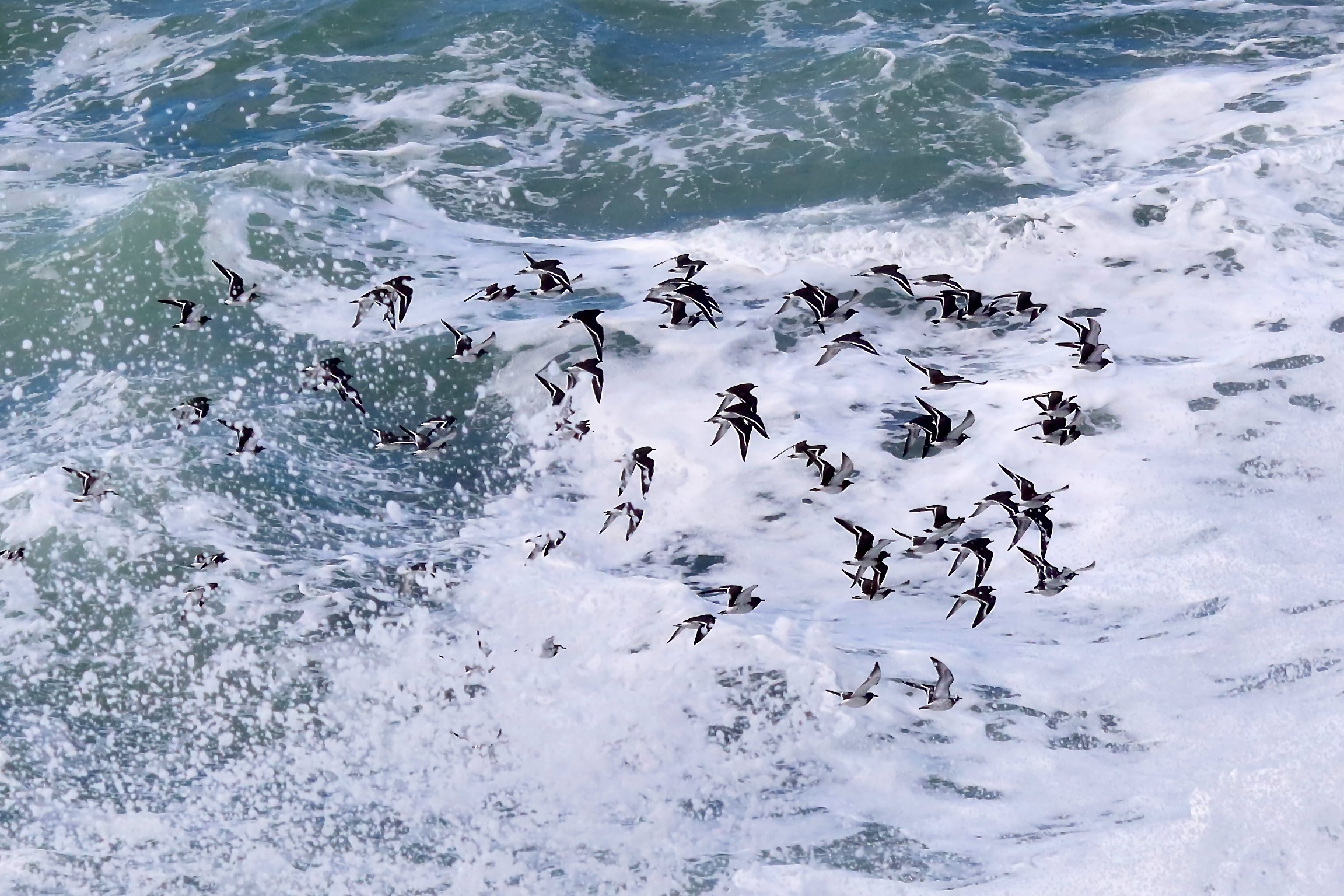
Art: "Fleeting" by Arianne Melton
Nonfiction: "Scales Becoming Skin" by AJ Smith
In the dark space, before I had eyes and ears and breathed air, I had hives. They were transported from my developing stomach to her arms and neck. She had them during the dark. They would haunt me for the following 21 years.
On my first day of kindergarten I told a blonde girl I had an oatmeal bath the night before. Her twisted nose and squinted eyes blared that this was not normal. On the drive home, I asked my mom if the baths were some kind of spell, warding off anaphylactic shock and itchy legs. She said the two were not related and solved separate problems. One was used to save my chronically cracking skin, the other was for my throat. It liked to close. I don’t think I believed her. Do you?
The first person to call me sensitive was my uncle. I told him my skin has always been this way. He told me it had to get thicker. He was wrong.
My childhood was plagued with vivid dreams of floating facedown in the Puget Sound. My body and mind rocked in the ferry’s wake. Once, when I was too young to know my own age, I almost drowned in a retirement home pool. My mother’s face was distorted by chlorine and turquoise silence. Fish allergies are known for appearing during adulthood and becoming the subject’s lifelong companion.
My first concussion brought me back to the pre-birth dark. In my curtain-drawn room, I spoke seldom. I pressed often on the swollen bump on my neck, and swam between earth, sleep, and another realm I will only return to after death. It was the second wave of tranquility. The first came the year before.
The wilderness was giving that day. I was leading the group. The guide said my pace was steady. I think the mountains wanted to reward me for slowing down. They were young, the mountains. I wonder, often, how they remember me. I worry sometimes that they don’t understand why I haven’t been to visit.
I can’t say how old I was the first time we went to the salmon run. I think it was before the pool. I was scared to open my mouth. I thought the water might splash and steal its way down my throat, making me barrel over the railing and float with them, the salmon and the unforgiving current, to our shared death. It’s okay to laugh, reader. I would if it weren’t my story.
Whenever I hear rushing currents, I am back in the wilderness, swept up in that first wave of tranquility, sweaty with a swollen eye and a backpack too big, begging for the noise to stay nestled between my ears. I’ve never envied anyone the way I do running water. I saw her ambition and it ignited my own. I wanted to be unattainable and life giving. I wanted to be essential, for my mind and hands to be needed for others survival. I still am not sure if that’s selfish or selfless.
I met the Italian mountains with blonde box dye and violet KT tape. I was 15, but felt 20. Everyone treated me like I should have been a different age. I acted like I was. I don’t know if I mean that. I spent the whole two weeks looking for windows into myself; through passing cars and poorly lit cafes, in hostel bathroom reflections that didn’t match my own. I was worried the natural world didn’t recognize me. I knew all too well what it called me to do. That, out there, I didn’t need to be attention drawing. That the decisions that brought me praise in the public sphere of adolescents wasn’t appreciated in the outdoors.
We spent the week discussing our hiking rituals, part of me still wonders if my aching knee was punishment from something higher and vengeful. It was the first time I didn’t camouflage. A senior told me rebellion is essential to gaining self identity. I wanted to agree, but I was sick at the thought of nature not recognizing me, relishing me, of not belonging to the trails and currents that had befriended me as a child.
What a shame we cannot dictate the advice we get rather than the advice we give. I wished she had told me nature takes just as much as it gives. I wonder when I started telling myself that. I think that’s why we’re so in awe of the natural world; it evolves and lives in spite of busy lives and lack of faith. God doesn’t stop being God when there is no one to praise him. The wild doesn’t stop living simply because we tried to starve it. I hope you don’t find me pessimistic, reader, I just think you deserve to not be lied to.
The second bodily loss connected me to the river, a climbing accident that ended not with swirling ocean currents like the first, but with the green backdrop of how my skin felt before it was flesh. My brain returned, briefly, to the dark. The days and weeks and months after were a wash of Tylenol PM and rotten chicken. I still can’t say who kissed who on the rock the following night. It may have been a dream. Would you prefer it were real, reader?
Water is the only place my brain doesn’t drag behind. During the first, I would spend eternity on the plaster floor. The shower baptisms brought knowledge that wasn’t mine to hold, leaving me both guilty and grateful to be trusted with something so obscure. A limited number of functions would be sufficient to rebuild the rest of me. Only there did I have a telephone line between mind and body, to the way the mist felt on my face at the salmon run, to the feeling I dreamt of — floating, lifeless in the Salish.
I apologize if this isn’t the story you wanted to spend the afternoon with, but it’s the only one I’ve got.
I spent the summer before college sleeping on some boy’s boat. That’s not true. I don’t know when it was, but I wish it was then. Perhaps if it had been that July, September wouldn’t have been a rerun of past advice and lost lessons. His space heater left my skin with scales. I’ve never felt more like a fish; out of water and painfully present for my lungs’ collapse. Have you ever wanted to be wanted so desperately you become something they didn’t ask for?
I mistook discomfort for adventure back then. My soul longed for the promised land of the first concussion. I wanted to be ageless again, to be back in the dark, to stay suspended in the comfort of being too young and dumb for my own good. The unfortunate truth is, I’ve never been so. I’ve baited you, reader, with the half truth, with the story truth of a quite ordinary and uninteresting recollection of things that never happened. I asked my mother about the conversation on the car ride home from my first day of school. She said it happened with a different adult. I asked my uncle, years later, if he still thought I was sensitive. He told me I told him that, not the other way around. I don’t know if any of this matters, but I want it to. I want the hives to be subdermal. I want to prove, more to myself than to you that I embody water. I want this account, faulty and flawed and inaccurate, to be essential.
I tasted the bay last month, hoping it would give me a vision of the river, of salmon, of purple KT tape or that boy’s boat. I was willing to drown for it. I don’t think I meant that; when you’re swallowing water, it feels like air.
Published July 18th 2026

AJ Smith (she/her) was born and raised on a small island off the coast of the Salish Sea. Celebrating moments and emotions that would normally be deemed insignificant has been the subject matter of her work since she picked up a pen. Her poem “Human Nature Numerology” was published in the Spring Issue of Jelly Squid Magazine. She is currently a senior at Western Washington University majoring in Creative Writing with an emphasis in Poetry and Nonfiction.
Arianne Melton is a writer, artist, and educator in Portland, OR. She has a BA in Theatre Arts: Design and Technical Concentration and an MAT from Lewis and Clark College. Arianne is deeply interested in capturing lived experiences moment by moment, from the simple to the complex. She is out to answer the question, “What does it mean to be right here, right now?” Sometimes the “right here, right now” is effortless, and sometimes it is excruciating, and she is here for both ends of the spectrum and everything in between. How does one capture such an ordinary and extraordinary life?