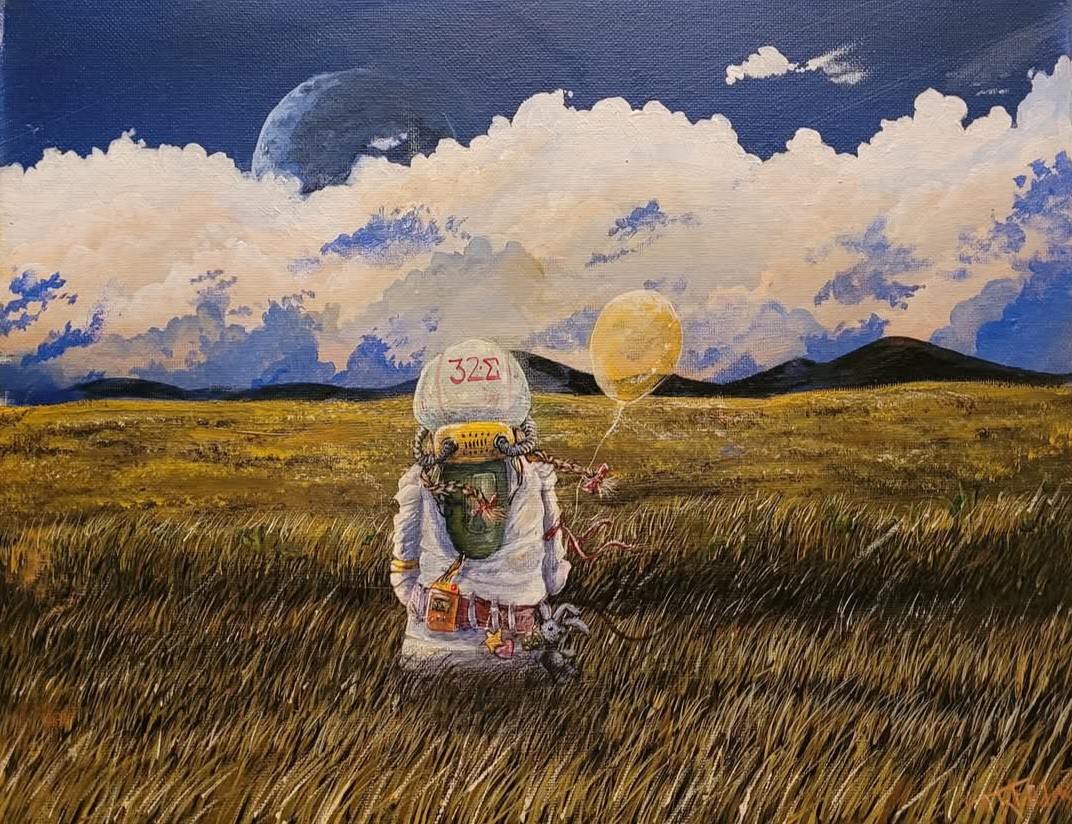
Art: "Happy Birthday" by T. R. Felder
Fiction: "Still" by Steve Mittelman
The first one I read about was Chad Miller, an accountant in Memphis, about a year ago now. The man had braved the September heat to pop next door for a sandwich, then froze on his way back to the office. One of his coworkers got worried and one found him standing completely still on the sidewalk, mid-step.
Mr. Miller’s eyes stared vacantly ahead, wide brimmed hat protecting his face from the brunt of the sun. He didn’t move when his friend called his name or even patted him on the shoulder, and his closed fist wouldn’t release the white plastic bag carrying his roast beef and macaroni salad when she tugged it. The paramedics were stymied and decided to bring him to the local hospital. However, the moment they tipped the body to lay him on the stretcher, he collapsed onto the hot pavement. After several minutes of CPR and multiple cardiac shocks, the man was declared dead. Cause of death: cardiac failure.
The second and third cases, in Padova and Tokyo, respectively, didn’t receive widespread press until after the fourth: a biochemistry professor in Los Angeles who froze in front of some three dozen witnesses. Dr. Alma Stalt was presenting her work on zebrafish endothelial cells when she stopped mid-sentence. Mid-word, in fact. A post-doctoral fellow recalled her saying, ‘To confirm the role of VEGF, we next performed immunoprecipitation using an anti—’. The audience knew she was going to say ‘antibody’, but her lips never finished that word. They pursed to make the ‘B’ and remained like that until her death, which occurred immediately after a well-meaning pediatric resident from the audience gently tried to guide her into a chair.
In the following weeks, people were being found ‘stilled’ with increasing frequency, up to nine or ten new cases each day by mid-October. No one could identify a pattern. People of all genders, all occupations were found in all sorts of situation: a teenager playing Fortnight on his computer, an elderly man standing in his shower, a woman in the back of an Uber. The youngest was a five-year-old in a London a movie theater discovered holding a piece of popcorn a centimeter from his open lips after the end credits. That one really got to me, since I have a niece about the same age. The most bizarre was a woman in Sao Paolo who froze in the gym while doing bench presses. She was found holding an 80 kg barbell several inches off her chest, arms bent as they held the weight mid-press.
All cases died tragically as soon as they were moved until a plucky twelve-year-old yelled and bared her teeth at anyone who approached, protecting her dad who stood frozen in the middle of a Dallas crosswalk. Authorities cordoned off the street and erected a tent around him, and scientists from the CDC examined him—after grudging consent from his daughter. The dad’s body was indeed perfectly still, inside and out. He showed no signs of breathing, no heartbeat, none of the normal sounds one’s intestines make as they lazily suck nutrients from prior meals. A pathologist claimed that the body is not—cannot be—dead, as evidenced by the lack of normal postmortem changes. Even after two weeks, the man’s muscles did not relax and then stiffen in the classic pattern of rigor mortis; his eyes stayed clear and moist, despite remaining open in the hot, dry air. The fact that the tissues showed no evidence of bloating or decomposition implied that the trillions of bacteria and other microbes that live on us and in us must have also been ‘stilled’.
Scientists concluded that the man was not just still, but frozen in time, where many of the natural laws of physics did not affect him. Indeed, the man’s skin temperature measured by a laser probe remained 98.7°F—a physical impossibility without a source of energy countering the dissipation of heat that should have been—must have been—occurring.
After that, authorities instructed the public to avoid contact with people who are ‘stilled’, and not to move them. The cases continued to increase; by Thanksgiving, several hundred people being found every day. Some still died when a well-meaning bystander or clumsy passerby moved them. An 80-year-old librarian was killed by a pigeon that landed on her shoulder and tipped her over. But in every city and town, hundreds to thousands of ‘stills’ survived, if that was the right word. Laying or sitting or standing perfectly motionless in their homes or restaurants, places of work or out on the street. Some were protected by friends and family, who sat vigil over their unmoving body, hoping for a cure or some miraculous recovery.
As spring came, the numbers became untenable. Many of my friends and family had been affected. Nearly a quarter of the population was thought to be still, though the government and news agencies responsible for making such estimates were dysfunctional at best. Besides the loss of the workforce, the inconvenience caused by the stilled bodies led to a breakdown in society. Getting into an elevator with a still was creepy, but tolerable. But an elevator door being held open by a still became unusable.
Unless something drastic was done.
And that’s when society really began to crumble. A woman quietly sacrificed a customer blocking the door to her sandwich shop. A man ‘accidently’ knocked his estranged wife off of a couch. Troubled souls were seen moving random stills for no explicable reason. The value of life lessened, dwindling and draining until it disappeared completely.
Things got really bad by summer. Scottie and I set up a generator and hoarded enough gasoline to last us a year or more. We walked through town without seeing another moving soul, weaving through human manikins and piles of debris to grab some of the few cans of food still left on the store shelves. My goals, my dreams all disappeared, replaced only by the need to survive. And even that faded into more of an inertia, going through the motions to eat and drink mainly to avoid the discomfort of not doing so.
My Scottie froze the afternoon of July 14th. Two weeks before our 12-year wedding anniversary, I found him standing in front of the microwave, right in the middle of a spider solitaire game on his phone. I didn’t scream, or even cry. I mostly felt guilt as I contemplated whether to move him, so I could get to my last source of cooking food. I lasted two days before I moved him, gently sliding the phone from his hand, then reaching around his torso from behind and pulling him back ever so slightly away. I was shocked as his body lost all tone, collapsing to the ground in a tangle of arms and legs despite my effort to hold him up. I dragged him to the back yard and left him behind some bushes, far enough from the house that I thought the smell shouldn’t bother me. I was right; a few weeks later I risked a look and found that his body had been dragged away by some animals.
Now it’s September, one year since this all began. The day the earth stood still, I guess. I’m sitting at my dining room table, working on a jigsaw puzzle I’ve already completed twice. I haven’t seen or heard from anyone for months. Maybe I’m the only one left. I’m Will Smith in that movie, only I don’t have a dog, and there’s no vampires around. I almost wouldn’t mind seeing a vampire; at least it would break up the boredom.
For some reason, I fear going still more than anything. I could end it all—have worked through a thousand ways I could do it—and even that doesn’t scare me as much as the thought of being in that strange state. The unknown, the helplessness. Remaining semi-alive for days or years until some animal puts an end to me. Or maybe not. Maybe I’d stay that way forever.
But the longer I go, the more I believe I’m somehow immune to being stilled. How else can I explain being possibly the last moving human on a planet of billions?
The puzzle pieces are getting blurry in the fading light. I rub my eyes, then stand up and stretch. Knowing that I’m special brings me comfort. I don’t know if I did something to deserve it, or it was just random luck. Either way, I’m in control of my destiny. I’ll either die of natural causes decades down the road, or I’ll decide when to end my life. When things get unbearable.
In any case, I won’t be subject to whatever—
Published January 2nd 2026

Steve Mittelman is a pediatric endocrinologist and scientist who has recently discovered a love of writing fiction.
T. R. Felder is professional artist from rural Texas with a love for teaching art. Growing up in the Piney Woods of Texas provided a wealth of inspiration paired with a love for fantasy and science fiction. T.R. Felder began her art journey in the mid 90’s with Nemesis Entertainment as a set designer for haunted castle displays for events. No matter where life took her, she did so with a brush in her hand. She has also donated her time periodically to various homeless and DV shelters teaching clients about art, painting techniques, and finding emotional well-being with a canvas and an open heart. Now with an empty nest, T.R. Felder dedicates her full time to learning and growing her skill as an artist.